How Many Drake 2-Bs Were Ever Made?
Counting Boatanchors with the German Tank Problem
I became interested in this question when Bill (N2CQR) was thinking out loud during an episode of the SolderSmoke podcast. He wondered how many Drake 2-B receivers the R.L. Drake Company had ever actually built, a question nobody at Drake is around to answer. The 2-B was a triple-conversion tube receiver without a crystal filter. Its final IF is 50 kHz (quite low!), and it employed an LC filter instead. It sold from roughly 1961 to 1966, a beloved boatanchor that still turns up at hamfests, but Drake apparently never published production totals.
At the time, I sent Bill an email about this question: There's a way to answer that, I told him — a lovely piece of wartime statistics called the German tank problem. However, it needed data, and I'd need his help. I asked Bill to ask his listeners to send in the serial numbers stamped on the backs of their 2-Bs. I could turn this data into an estimate. He put out the call on the next show, and the numbers came in via blog comments, emails, tweets, and Facebook messages. Bill even joked about carrier pigeons. When enough had piled up, he passed them on to me to run an analysis.
What follows is how that worked, and it's a great excuse to look at the same question two different ways: the frequentist way and the Bayesian way.
The wartime version
During World War II, the Allies wanted to know how many tanks Germany was producing. As it turns out, spies and aerial reconnaissance gave wildly inflated guesses. Statisticians took a different route. German tanks (and their gearboxes, wheels, and engines) carried sequential serial numbers, and every now and then, the Allies captured or destroyed one and could read the number off it. From a handful of captured serial numbers, the statisticians wondered, "Could you estimate the total?"
You can, and remarkably well. The post-war analysis was remarkable. For one stretch of the war, conventional intelligence estimated about 1,400 tanks a month, the serial-number method estimated around 245, and the captured German records put the true figure at 245. The spies were off by a factor of five, but the maths was off by essentially nothing.
Who actually came up with this? There's no single inventor. The technique was put to work by statisticians and economists in the Allied Economic Warfare Division — running serial and chassis numbers off captured German tanks, tyres, trucks, and even V-2 rockets — and the first published account is Richard Ruggles and Henry Brodie's 1947 paper in the Journal of the American Statistical Association. The mathematics that proves why the estimator is the best possible one came together separately around the same time: the Rao–Blackwell theorem (C. R. Rao, 1945; David Blackwell, 1947) and the Lehmann–Scheffé theorem (Erich Lehmann and Henry Scheffé, 1950) are exactly the tools that turn "the highest number you've seen" into the minimum-variance unbiased estimate we'll use below. The Bayesian view came later still, as a textbook reframing of the same puzzle.
The same idea has since been used to estimate Commodore 64 production, iPhone sales, and once Bill got his listeners going, Drake 2-B receivers.
The setup
Imagine the radios were numbered 1, 2, 3, … up to some unknown total N. We've observed a random sample of k of them, and the largest serial number in our sample is m. We want a best guess for N.
The whole thing rests on one assumption: that the serial numbers we happen to see are a fair, unbiased sample — that a radio with a high number is no more or less likely to reach us than one with a low number. For the tanks, this was about which ones got knocked out on the battlefield. For us it's about which owners happen to listen to a ham radio podcast and bother to walk over and read the back panel. More on whether that's fair below, so hold the thought.
The frequentist answer
Here's the intuition I gave Bill at the time, because it's not very maths-y and doesn't rely on years of statistical experience to follow.
Suppose you've seen exactly one radio, number m. What's your best guess for the total? Your single observation is, on average, going to land somewhere in the middle of the range, so a sensible guess is that the true top is about twice your observation — N ≈ 2m. This does assume there is no bias in your sampling of m. Now suppose you've seen two radios. The bigger of the two is probably closer to the top, so you'd scale up by less, roughly 1.5×. Three radios, fewer again. The more radios you see, the more confident you can be that your highest observation is already near the real ceiling, and your multiplier creeps down toward 1.
That intuition is expressed by this estimator, where the ^ on N means 'estimate of the true N':
N̂ = m (1 + 1/k) − 1
Read it as "the highest number you've seen, plus one average gap, minus a discrete-counting correction." If serials are evenly sprinkled through 1…N (unbiased), the typical spacing between them is about m/k, and the real top is, on average, one such gap above the biggest one you happened to catch. So you take your maximum and add a gap. With k = 1 it doubles your observation; as k grows it converges down onto m, which is just what it should do.
This is the minimum-variance unbiased estimator (MVUE) — among all unbiased methods, it's the one that wobbles the least from sample to sample. It is also gloriously simple: you need only two numbers, the largest serial and how many you've got.
The 2-B numbers (2011). In 2011, Bill's listeners produced 23 serial numbers. The highest was 12955. So m = 12955, k = 23:
N̂ = 12955 × (1 + 1/23) − 1 ≈ 13,517
So at the time, we concluded that the highest 2-B serial number ever stamped was probably around 13,500.
But the serials don't start at 1
But there was a complication I flagged at the time and couldn't fully close: Drake didn't start at serial number 1. Chasing this down later, the consensus among 2-B collectors, pieced together on SolderSmoke itself, is that the first 2-B had serial number 2000 and came from the first production run in April 1961.**
Here's the part I find genuinely amazing, elegant, and satisfying - it's one of the reasons I really love maths. The lowest serial number anyone reported to us was 2008 — just eight radios above the suggested floor of 2000. We didn't assume that floor to make the numbers work. It was proposed independently by collectors reasoning about Drake's production history, and our data completely reinforced this pubic impression. And the next-lowest numbers reinforce it further: 2046, 2258, 2532, all sitting just above 2000 and none below it. If the production line had really begun at 1, or at 500, or at 5000, that clustering would be an extraordinary coincidence. Instead, it's exactly the fingerprint a floor of 2000 would leave. Two independent lines of evidence, the collectors' history and the serial numbers themselves, agreeing to within eight units is about as good as this kind of amateur archaeological mathematics gets.
A later find made that fingerprint even sharper. In 2013 Paul Brock, K4MSG, showed SolderSmoke serial 2052 — an early radio, fifty-two units above the proposed start, and still not below it. I'll come back to why that empty space under 2000 matters.
If the line runs from about 2000 to about 13,500, then the number of radios actually built is the length of that interval, not the top of it:
units built ≈ 13,500 − 2,000 ≈ 11,500
You can do this more cleanly by shifting every serial down by 1999 so the first radio becomes "number 1," applying the formula, and reading off the count directly. That gives roughly 11,400 units from the 2011 data. So let's say 11,5000 Drake 2-Bs were built.
(If you're feeling rigorous, you can also drop the assumption that the start is known and estimate both ends from the smallest and largest serials at once. That nudges the count up to about 11,900. The fact that "assume the floor is 2000" and "estimate the floor from the data" land within a few hundred of each other is itself reassuring. It means 2000 is a believable floor.)
The Bayesian answer
The frequentist gives you a single best number. The Bayesian approach asks a subtly and not so subtly different question: given the data, what's the whole distribution of plausible totals, and how sure should we be? I prefer this level of thinking, although it makes estimation more complex to perform and interpret.
For the Bayesian approach, you start with a prior guess, which is a distribution of possible answers, not a single answer, before seeing any serials. Our prior is, 'suppose every possible total N as equally believable' (a flat prior). Then ask, for each candidate N, how probable our actual sample was. The key fact: if there are really N radios and we draw k of them, the chance that our particular set fits inside 1…N is governed by how many ways k radios can be chosen from N, which is the binomial coefficient C(N, k). Bigger N means more ways to have drawn other radios instead, so larger totals are penalized. The posterior probability of each N is proportional to 1 / C(N, k)for every N at least as large as the maximum we observed.
That posterior has a long tail to the right — it rules out anything below m hard (we've seen m, so the total can't be smaller), but it allows ever-larger totals with steadily shrinking probability. The mean of the estimator (N̂) has a tidy closed form:
N̂_Bayes = (m − 1)(k − 1) / (k − 2) (for k ≥ 3)
Like the frequentist formula, it's "your maximum plus a bit," but because the posterior assigns large values equal probability, that "bit" is slightly larger. The two methods agree on the shape of the answer and differ only in temperament. The frequentist hands you a point and stops; the Bayesian hands you a point and an honest sense of the spread of possible answers. This is why I love Bayes in modeling and answering questions like this.
The 2-B numbers, Bayesian (2011), counting from a floor of 2000:
- Posterior-mean estimate: ≈ 11,477 units built
- 95% credible interval: roughly 10,970 to 12,950 units
In plain words: given 23 serials, we'd have been about 95% confident that Drake built somewhere between eleven thousand and thirteen thousand 2-Bs — and our single best guess, whichever school you belong to, sits right around eleven-and-a-half thousand. But Bayes gives you a range to consider, and that tightness of range and shape of the density of that range gives you so much more than just the mean estimator. So much more to think about. Best-case scenarios. Worst-case scenarios. That sort of thing. It doesn't leave you with just a single number which canbecome too much of a focus when answering questions.
Frequentist vs Bayesian, side by side
It's worth dwelling on why they nearly agree here, because the German tank problem is one of the cleanest places to see the two statistical philosophies meet.
The frequentist estimator is built to be unbiased: average it over many imaginary repetitions of the experiment, and it lands on 'the truth'. It is silent about any one experiment's uncertainty unless you separately work out its variance.
The Bayesian estimator starts from a prior and reports a full posterior distribution after seeing data, from which a credible interval falls out for free. With a flat prior and a decent sample, the two philosophies converge, which is exactly what we see: 13,517 (frequentist top serial) versus a Bayesian posterior implying a top serial around 13,476. The daylight between them is smaller than the uncertainty either one carries, so for practical purposes, the 2-B answer is robust to the method you use here. That robustness is the real result. When two different statistical worldviews, fed the same modest pile of hamfest serial numbers, both point at "about 11,500 radios," you can believe the number. But again, should we 'believe' in a number, or should we consider a credible range? I beleive we should consider a credible range.
A 2026 refresh
Here's something fun about leaving a blog post open for fifteen years: data keeps arriving. People are still finding this old SolderSmoke thread, walking over to their 2-B, and adding their serial number in the comments. Since the original analysis, eight more have come in — 2046, 2258, 2532, 4226, 6541, 7856, 10206, and 11093. The last of those came in 2021.
None of them exceeds 12955, so our maximum observation is unchanged. But more samples sharpen the estimate. Re-running everything with all 31 SolderSmoke serials, then the later eBay and K4MSG additions:
| Quantity | 2011k = 23 | SolderSmokek = 31 | June eBayk = 35 | Nowk = 47 |
|---|---|---|---|---|
| Highest serial (m) | 12,955 | 12,955 | 12,955 | 12,955 |
| MVUE top serial | 13,517 | 13,372 | 13,324 | 13,230 |
| Units built (floor ≈ 2000) | ~11,431 | ~11,308 | ~11,268 | ~11,188 |
| Bayesian mean units | ~11,477 | ~11,333 | ~11,287 | ~11,198 |
| Bayesian 95% interval | 10,968 – 12,953 | 10,965 – 12,387 | 10,964 – 12,209 | 10,962 – 11,868 |
Our estimate barely moves. It is still about 11,200 radios. But look at the credible interval. The lower bound is rock-solid (it's pinned just above the highest serial we've seen), while the upper bound has pulled in from ~12,950 toward ~12,000. Extra data points didn't change where we think the answer is; they changed how confidently we can rule out the possibility that there's a big stash of high-numbered 2-Bs we never sampled. That's the German tank problem showing off its best.
An eBay pass (2026)
While revisiting this in 2026, I tried another source: eBay listings for Drake 2-B receivers. Sellers often photograph the back panel, and the serial number is right there in the listing photos or description. Searching active and recently sold listings turned up four more distinct numbers we had not seen before: 4368, 5596, 10140, and 10283.
None of these exceeds 12955 either, so m is still 12,955 — the headline location of the estimate does not shift. What changes is k, from 31 to 35. That is exactly the lesson the widget is built to show: when the maximum stays put but the sample grows, the posterior does not wander sideways; it tightens. The credible interval's upper bound pulls in another ~180 units (from ~12,387 to ~12,209), and the curve on the plot grows a little taller and narrower. Compare the 2026 SolderSmoke and June 2026 + eBay presets in the widget below and watch the band squeeze inward even though the dashed and solid estimate lines barely budge.
eBay is worth revisiting from time to time. Listings come and go, and a fresh search might turn up serials we have not logged yet. Those later passes live in the eBay log below, so this page stays one running record instead of a stack of dated updates. If the new numbers all sit below 12955 — which is the most likely outcome, since that is still our highest observation by a wide margin — then the story stays the same: k ticks up, the credible interval squeezes a little further, and the point estimate creeps down imperceptibly toward the maximum we have already seen. Each extra serial below the top matters less than the one before it; that is the diminishing-returns shape of the German tank problem once you have a decent sample and a stable maximum.
If someone ever lists a 2-B with a serial above 12955, that would be a different kind of event entirely. A single new maximum would move m, reset the floor of the posterior, and shift both the frequentist and Bayesian estimates upward in one step — potentially by hundreds of units, depending how far above 12955 the number sits. So far, fifteen years of SolderSmoke comments, the WB4HFN database, and every eBay pass so far have all failed to find one. That is reassuring evidence that 12955 really is near the ceiling, but eBay remains one of the easier places to keep checking, because the serial is often visible before anyone has to ask.
eBay log
This is the running log. I go back to eBay now and then, read the rear-apron photos, and add any new serials here. Last searched 17 September 2026. Readable stamps now live in the serial catalog.
August 2026. Five 2-Bs were listed. Two of them we already had from June — 4368 and 10283, still showing the serial on the rear apron. The other three were new: 2221, 5119, and 6156. None of them beats 12955, so m is still 12,955. Sample size k went from 35 to 38. The point estimate barely moved (Bayesian mean ~11,287 → ~11,259). The useful change was the interval: the 95% upper bound pulled in another ~100 units, from ~12,209 to ~12,102.
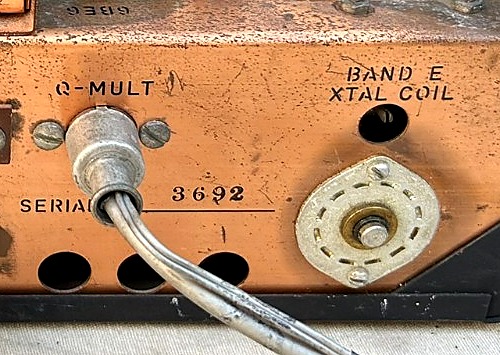
September 2026. Another pass. Three listings had a readable serial we did not already have: 3692, 2711, and 11435. A few other 2-Bs were still up from August, or had chassis photos and no rear apron. None of the new numbers beats 12955, so m is still 12,955. After K4MSG's 2052 (below) had already taken k to 39, these three take it to 42.
The number that actually changes the story is 3692. Until this pass the 3000s were an empty thousand on the histogram — the one gap that made a skip-block look plausible. A 3xxx radio was the photo that would settle it. eBay supplied one. The P.S. below is rewritten for that.
A comment on this post is not eBay, but it is a new serial: Brian Mathews reported 9215 on 30 August 2026. That takes k from 42 to 43. Bayesian mean ~11,251 → ~11,222. The 95% upper bound is ~11,959.
14 September 2026. Another pass over the active listings. Two radios had a stamp we did not already have: 2598 (sitting right next to our 2599) and 4028 (right next to 4025). 2221, 4368, 10283, and 11435 were still up. Sold listings wanted a sign-in, so this pass is the live search only. None of the new numbers beats 12955, so m is still 12,955. Sample size k went from 43 to 45. Bayesian mean ~11,222 → ~11,210. The 95% upper bound pulled in from ~11,959 to ~11,912.
Serial 10219 — mine
This one did not come from eBay or from notes sent in to soldersmoke! In September 2026 Steve Reed, KW4H, refurbished a 2-B and a 2-BQ and sent them to me as a gift for the work on these serial number counts. The rear-apron stamp is 10219. The longer thank-you is a separate post; the plate is now also in the serial catalog. For the statistics, sits between 10206 and 10283, so m is still 12,955. Sample size k went from 45 to 46. Bayesian mean ~11,210 → ~11,204. The 95% upper bound pulled in from ~11,912 to ~11,889.
16 September 2026. Two more readable stamps: 2711 and 2976. Neither beats 12955, so m is still 12,955. Sample size k went from 46 to 47. Bayesian mean ~11,204 → ~11,198. The 95% upper bound pulled in from ~11,889 to ~11,868.
17 September 2026. Another pass over the live search. No new stamps. 2221, 2598, 2711, 2976, 4028, 4368, and 10283 were still listed. 11435 had ended. One other 2-B still has chassis photos and no rear-apron stamp. Sold listings wanted a sign-in, so this pass is the live search only. m is still 12,955 and k stays 47.
K4MSG's 2052, and the empty space below 2000
There is one more serial that belongs in this pile, and it matters for a different reason than the eBay finds.
In July 2013 Harv, WA3EIB, posted pictures of one of the earliest surviving 2-Bs: Paul Brock, K4MSG, serial 2052. (Oldest Drake 2B?) I had left it out of the earlier recount. Adding it takes k from 38 to 39. Because it sits nowhere near our maximum, the German tank estimate barely notices — Bayesian mean ~11,259 → ~11,251, interval upper bound ~12,102 → ~12,070. That is not why 2052 is interesting.
2052 sits at the other end of the line. Our proposed floor is 2000. The lowest radio in the sample is still 2008, eight units above that floor. K4MSG's radio is the third-lowest: fifty-two units above 2000, tucked between 2046 and 2221. It is an early radio. It is not a radio from below 2000.
That is the result that would have actually changed the floor story, and it still has not happened. Every time a new low serial arrives — 2008, then 2046, then 2052, then 2221 from eBay — it lands in the same narrow band just after 2000. The region below 2000 stays empty. If Drake had started at 1, or 500, or 1500, that empty band would be an increasingly awkward coincidence as the sample grew. Instead it keeps looking like a wall. The collectors said the first production 2-B was serial 2000. The serials themselves have never contradicted them.
Play with the numbers yourself
The lovely thing about the German tank problem is that the estimate depends on only three things: the highest serial you've seen, how many radios you've sampled, and where the production numbers start. So you can recompute the whole analysis live. Try the 2011, 2026 SolderSmoke, June 2026 + eBay, and current presets, or move the starting serial off 2000 and see how directly it shifts the count. The curve is the Bayesian posterior over the total number built; the dashed vertical line is the frequentist estimate, and the solid vertical line is the Bayesian mean. The height of the curve is a genuine probability: it represents the chance that the true total lies within roughly 100 radios of that point, peaking around 27% in our data. (Plotting it this way keeps the numbers readable — the probability of any single exact total is about a hundred times smaller, only a fraction of a percent, simply because the mass is spread across thousands of possible whole numbers.)
Two deliberate choices make the changes easy to see. First, the axes are fixed — the horizontal window and the 0–100% vertical scale don't rescale as you drag the sliders, so the curve genuinely grows taller and narrower in front of you instead of looking the same while the axis numbers quietly change underneath it. Second, a faint dashed reference curve stays pinned to the original 2011 sample (k = 23). As you increase the sample size, the solid curve climbs above the ghost and squeezes inward — a direct visual picture of more data buying more certainty.
Here's the thing to play with: drag the sample size k up high, or step through the presets from 2011 → 2026 SolderSmoke → June eBay → current, and watch two things happen at once. The credible-interval band squeezes inward, and the dashed (frequentist) and solid (Bayesian) lines slide together until they're almost on top of each other. That convergence — two different statistical philosophies agreeing more and more as the data grows — is exactly what happened when those eight extra SolderSmoke serials arrived, and again when the eBay serials turned up. More data doesn't just sharpen one estimate. It makes the rival methods agree.
For the record, here is the full set of serial numbers in the analysis — every distinct one from the SolderSmoke collection thread and its comments, K4MSG's 2052, Brian Mathews' 9215, the eBay recoveries, and my own 10219 (47 in all, the highest being 12955):
2008, 2046, 2052, 2221, 2258, 2532, 2598, 2599, 2711, 2976, 3692, 4025, 4028, 4226, 4368, 4950, 5119, 5149, 5153, 5254, 5596, 6152, 6156, 6373, 6541, 7856, 8069, 8682, 8873, 9041, 9180, 9215, 9289, 10140, 10206, 10219, 10283, 10328, 10616, 11059, 11093, 11222, 11435, 11976, 12038, 12060, 12955
The widget starts loaded with exactly these numbers; hit a preset to compare the 2011, SolderSmoke-only, June eBay, and current snapshots, or "Load the full serial list" to drop them all back in.
German tank problem — Drake 2-B estimator
Adjust the inputs; everything recomputes instantly. Estimates use only the highest serial, the sample size, and the starting serial.
Advanced: paste your own serial numbers
When you use a pasted list, the sample size and highest serial are read straight from it. The “Load the full serial list” button fills this in with all 47 numbers (SolderSmoke, K4MSG 2052, Brian Mathews 9215, eBay, and KW4H 10219).
| Sample size (k) | |
| Highest serial (m) | |
| Frequentist top serial (MVUE) | |
| Frequentist units built | |
| Bayesian 95% credible interval | |
| Bayesian best estimate (units built) |
The caveats (there are always caveats in statistics)
The whole edifice rests on that uniform-sampling assumption, and it's worth being honest about where that might fall apart:
- Survivorship. We only ever read serials off radios that still exist. If early 2-Bs were scrapped at a different rate from late ones, our sample would be skewed. The clustering of low numbers just above 2000 — 2008, 2046, 2052, 2221 — suggests that early units survive fine. This provides some verification of our assumptions.
- Self-selection. Our sample is "2-Bs owned by people who listen to SolderSmoke and chose to report." There's no obvious reason that should correlate with the serial number, which is precisely the condition this method needs, but it's an assumption, not 'proof'.
- Gaps and restarts. The maths assumes one unbroken run of numbers. If Drake skipped blocks, restarted sequences between production years, or shared a numbering scheme with another model, the estimate would drift. The clean fit to a single 2000-to-~13,500 line is encouraging but not conclusive.
None of these is fatal, and the fact that multiple methods and two independent statistical philosophies all converge on the same neighbourhood is the best evidence we have that the assumptions are roughly holding.
So, the answer
R.L. Drake built somewhere in the neighbourhood of 11,000 to 12,000 Model 2-B receivers, most likely right around 11,200, with the very last one carrying a serial number a little under 13,300. We arrived there not from a factory ledger but from a few dozen hams reading the backs of their radios and a formula the Allies used during World War II.
There's something deeply satisfying about that for me. A wartime statistical trick, a community of boatanchor enthusiasts, and a pile of serial numbers, adding up to a real answer about a sixty-year-old radio. Keep those numbers coming. Every new one tightens the interval a little more.
73 — Scott, K6AUS
P.S. Flatness assumption tests
The German tank problem only works if a 2-B that happens to reach us is equally likely to carry any serial on the line — a flat sample. If early radios were more likely to be reported, or late ones more likely to turn up on eBay, or Drake skipped a block of numbers, that assumption would be doing real work that the formula never sees. So after lining the 47 serials up on a number line, I ran the obvious check: do they look like a uniform draw from 2000 to 12955? (Technically: treat the maximum as given, and ask whether the other 46 sit uniformly on that interval. That is the fair version of the question once you have already used 12955 as m.)
Here are the 47 serials on the production line, and the same data binned by thousand. The accent tick in the 3000s is 3692, the radio that filled the empty thousand. The dashed line on the histogram is the flat-sample expectation (~4.3 radios per bin).
Observed serials along the line
One tick per radio. Early cluster (2008–2976) is drawn heavier; 3692 and 12955 are the accent ticks.
Rug plot of all 47 serials. Axis is the stamped serial number, from the 2000 floor to a little past the observed maximum.
Count per thousand-serial block (2xxx–12xxx). Dashed line = 47 / 11 ≈ 4.3, what a perfectly flat sample of this size would put in each bin.
The tests
Each test is picky about a different kind of “not flat.” Greenwood notices large gaps — the biggest remaining hole is now 6541 to 7856.
| Test | Statistic | p-value |
|---|---|---|
| Kolmogorov–Smirnov | D = 0.14 | p ≈ 0.31 |
| Anderson–Darling | A² = 2.16 (5% crit ≈ 2.49) | not unusual |
| Chi-square, 11 bins | χ² = 14.55 on 10 df | p ≈ 0.15 |
| Chi-square, 5 bins | χ² = 6.94 on 4 df | p ≈ 0.14 |
| Greenwood spacings | G = 0.0514 (null mean 0.043) | p ≈ 0.055 |
Tests treat the 46 serials below the maximum as uniform on 2000–12955. KS / chi-square p-values are Monte Carlo (20,000–30,000 draws). Greenwood is a one-sided upper test for uneven spacings.
KS, Anderson–Darling, and both chi-squares still have large p-values. Scatter this uneven, with a sample this small, is ordinary on those tests. You would see piles and thin patches like ours quite often if you drew 47 radios at random from a truly flat line. With only 47 points they are also not very powerful — they would only fire if the pile were badly skewed — but "not unusual" is still the honest summary for the CDF and the histogram.
Greenwood is only borderline (p ≈ 0.055). 2711 and 2976 sit in the old 2599–3692 stretch, so that hole is now two smaller gaps (2711 → 2976 is 265; 2976 → 3692 is 716). The biggest remaining hole is 6541 → 7856 (1,315 units). The 3xxx bar is still 1. The stretch Greenwood is chewing on is still the 7000s — a hole that never lined up with a neat empty thousand.
I still find myself noticing the early pile. The 2000s are not just present, they are crowded (2008, 2046, 2052, 2221, 2258, 2532, 2598, 2599, 2711, 2976), which is the opposite of a slow start, and the little WB4HFN QC-tag database — only five 2-Bs, so take it lightly — still jumps from serial 2008 (1 April 1961) straight to 4025 (1 November 1961). That source has no 3xxx 2-B. Ours now does. A reserved block, a shared scheme with another model, or a batch that never shipped are harder to keep on the table once a 3xxx radio has been photographed on a rear apron. The 3xxx bin is still thin. So is 7xxx. Thin is not empty, and empty was the claim that needed a photo.
A 2-B with a serial above 12955 is now the number that would actually move the estimate. If you have one, that is the most useful number anyone could send.
Acknowledgments: this was a collaboration that began with an off-air note and Bill's willingness to run with it — thanks to Bill, N2CQR, for raising the question on the podcast, putting out the call, and keeping the thread alive all these years, to Steve Reed, KW4H, who later put serial 10219 in my hands, and to every ham who walked over to their 2-B and reported what they found. The original collection and analysis live on the SolderSmoke Daily News blog (July and August 2011); the serial-number floor of 2000 comes from the collective sleuthing in the "Oldest Drake 2B?" thread; K4MSG's serial 2052 is from Harv WA3EIB's 2013 follow-up.