Testing Harmonics and Power Output of some Baofengs (Old and New)
One thing that surprises many hams: those cheap Baofengs often fail the FCC's spurious-emission specs right out of the box. So why are they legal to sell and use as ham gear? Well, I'm glad you asked!
It's because amateur radio regulates the operator, not the equipment. A commercial or GMRS radio must be factory-certified, so it's guaranteed to perform no matter who picks it up. The user isn't expected to know or care about the quality of what's coming out of the antenna.
Ham radio flips that around: as a licensed operator, the rules hold you responsible for keeping the signal clean, whether it's a quality rig, a cheapo handheld, a modified old rig, or a transmitter built from scratch. The ham should be doing the same job that factory certification does for a GMRS radio. That's exactly why a Baofeng may be legal for a ham to put on the air — not because it's guaranteed clean, but because it's on the ham to verify whether it's clean and, if it isn't, to filter until it is. Whether the radio passes or fails is never the manufacturer's promise; it's the ham's responsibility.
I mean, that's why hams have to pass a test and understand things like deciBels (dB), watts (W), and harmonics. We are supposed to know some stuff. So let's explore some Baofengs I happen to have lying around and their outputs.
The Setup
Accurate measurements require deep electrical engineering knowledge and calibrated equipment, but we'll do our best with available tools. I'll use a tinySA spectrum analyzer, available from Amazon or a Ham store, in Harmonic Mode, measuring signal levels at the fundamental frequency (2-meter simplex calling frequency, 146.52 MHz) and up to the 8th harmonic. The analyzer can't handle full power from the HTs, so I use two series 40 dB attenuators, reducing a 5-watt (37 dBm) signal to around -43 dBm (0.050 μW), which the TinySA can handle without damage. We'll also need the transmitting radio we are testing, coax, and connectors. See the setup below:
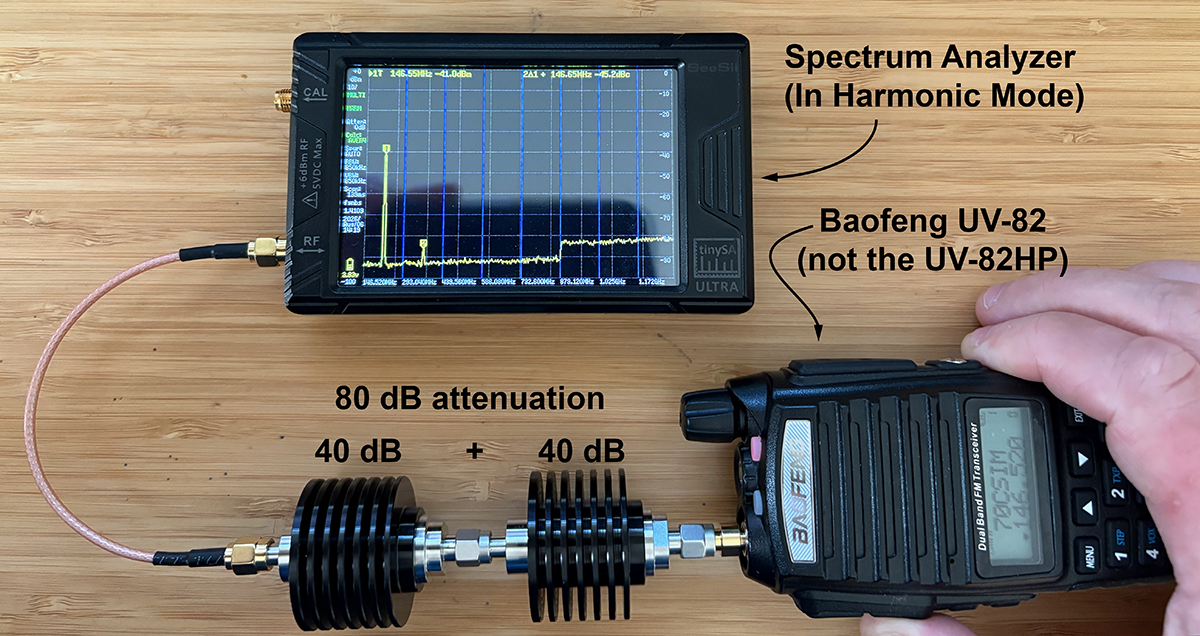
For a sanity/purity check, I decided to work with an old Icom W32A HT I happen to have. It's actually my first amateur radio I bought just after getting licensed as a Technician back in 2000. So this thing is old, and its battery barely takes or holds a charge. But it will key up some local repeaters. Nominally, on a good charge or with 12 V in it, it will deliver about 5 Watts. For some reason (I forget why), I recall it only gives about 3 W on battery, so that's what I expect. I also expect it to be really clean with no harmonics - this is Icom tech, not Baofeng tech. Below is the trace from the tinySA Spectrum Analyzer in harmonic mode. Let's look at it and discuss what all this means:
Icom W32A
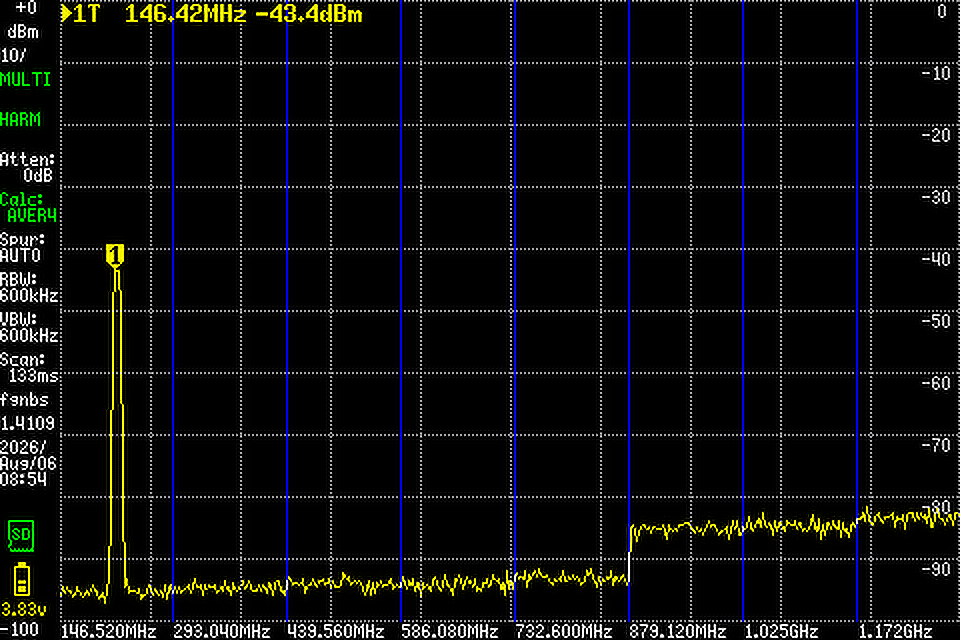
In this Harmonic Mode, the tinySA displays several side-by-side subplots of the RF energy at the fundamental (146.52 MHz in our case today) and upward through the second (2x146.52 MHz), third (3x146.52 MHz), and so forth up to the 8th harmonic from left to right. The subplots are separated by blue vertical lines. You can clearly see that there is energy only in the first harmonic (the fundamental). So this is a very clean signal. You can also see that its power is coming in at -43.4 dBm. The tinySA is configured with no additional attenuation or in-line autoattenuation, so it reads a power level of -43.4 dBm directly.
The two pads are labeled 40 dB each, so the obvious move is to add 80 dB: −43.4 + 80 = 36.6 dBm, about 4.57 watts. That was too high for this Icom on a tired battery. My first fix was to treat the pads as 1.8 dB light so the Icom landed at 3 watts, the figure I remembered. That put the UV-5R Mini at a tidy 5.0 W — which looked like confirmation. It was not. A later check showed the Mini was actually putting out 3.7 W. I am blaming the pads, not the tinySA: the pair is 76.9 dB, not 80 dB (3.1 dB light of the labels). Add 76.9 dB to the screen reading and the Mini is 3.7 W; the Icom comes out around 2.2 W, which is still plausible on that battery. The harmonic ratios (dBc) do not move; those are relative. Absolute watts and the 25 µW column do. The table below uses this pad figure.
The Measurements
Below is the entire table of results for all the radios I had on hand. Along with each power measurement, before and after attenuation/calibration correction, I show the presence of the strongest harmonic power for each radio. On this scale the so-called 5-watt HTs come in around 3½–4 W, and the UV-5RM is closer to 7 W than 10 W. The harmonic levels, however, require a deep dive interpretation.
2 m Spectrum Captures — Power & Harmonics
| Full name | Screen (dBm) | Power (dBm) | Power (W) | Worst harmonic | Target (dBc) | 25 μW test |
|---|---|---|---|---|---|---|
| Icom IC-W32A | −43.4 | 33.5 | 2.2 W | none seen | −49.5 dBc | below noise |
| Baofeng UV-82 | −40.7 | 36.2 | 4.1 W | −45.0 dBc@ 2f | −52.2 dBc | 130 μW ✘ |
| Baofeng UV-5R Mini | −41.2 | 35.7 | 3.7 W | −44.4 dBc@ 5f | −51.7 dBc | 134 μW ✘ |
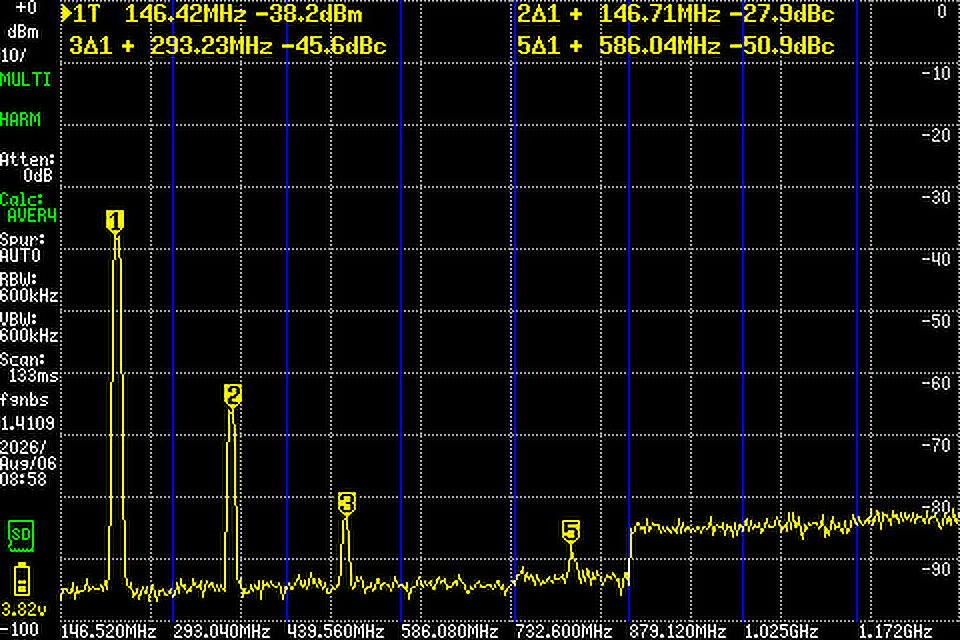
| Baofeng UV-5RM | −38.2 | 38.7 | 7.4 W | −27.9 dBc@ 2f | −54.7 dBc | 12 mW ✘ |
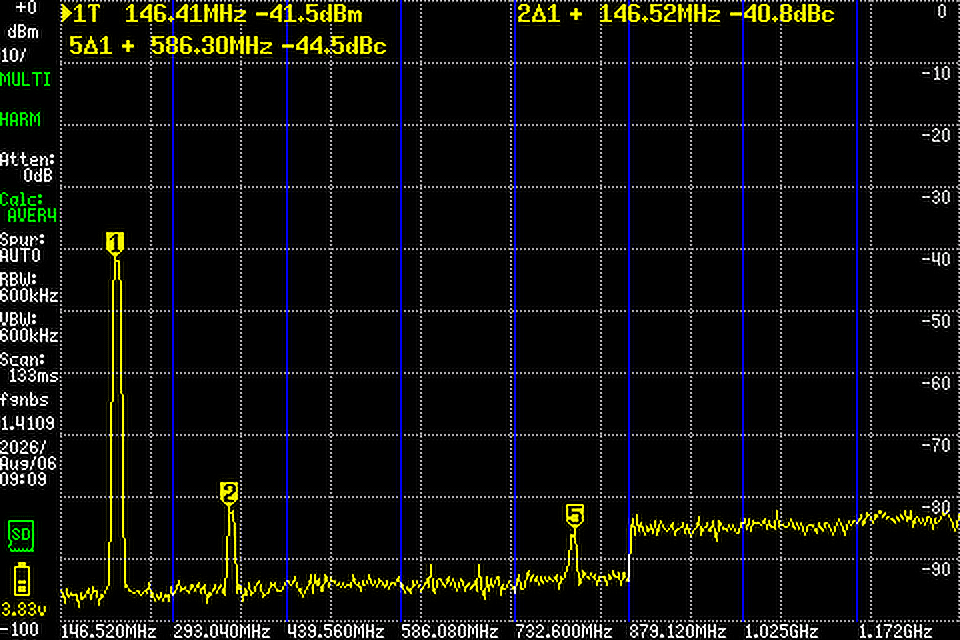
| Baofeng UV-5RM filtered | −41.5 | 35.4 | 3.5 W | −40.8 dBc@ 2f | −51.4 dBc | 291 μW ✘ |
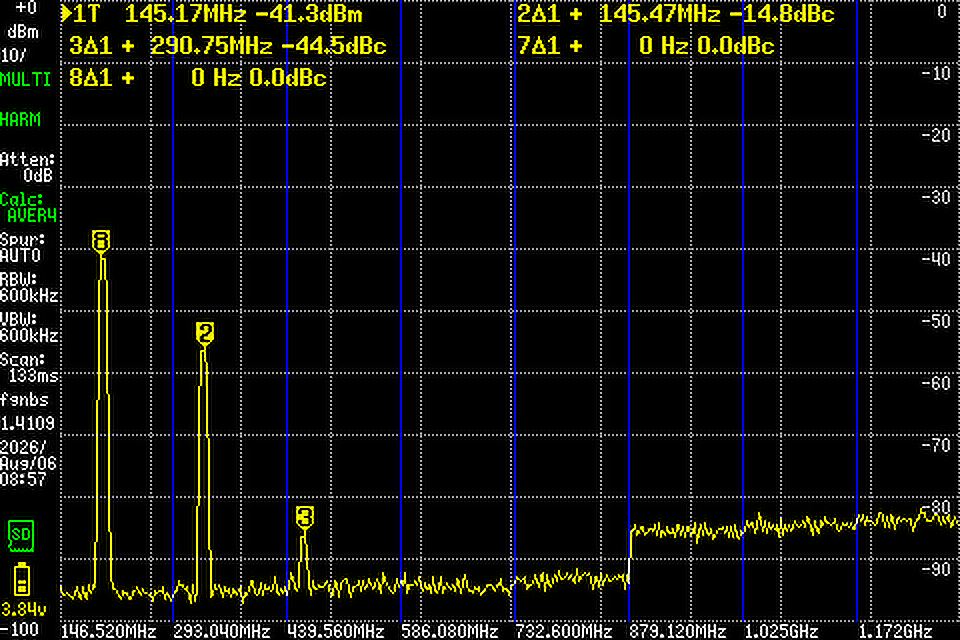
| Baofeng UV-5RX3 | −41.3 | 35.6 | 3.6 W | −14.8 dBc@ 2f | −51.6 dBc | 119 mW ✘ |
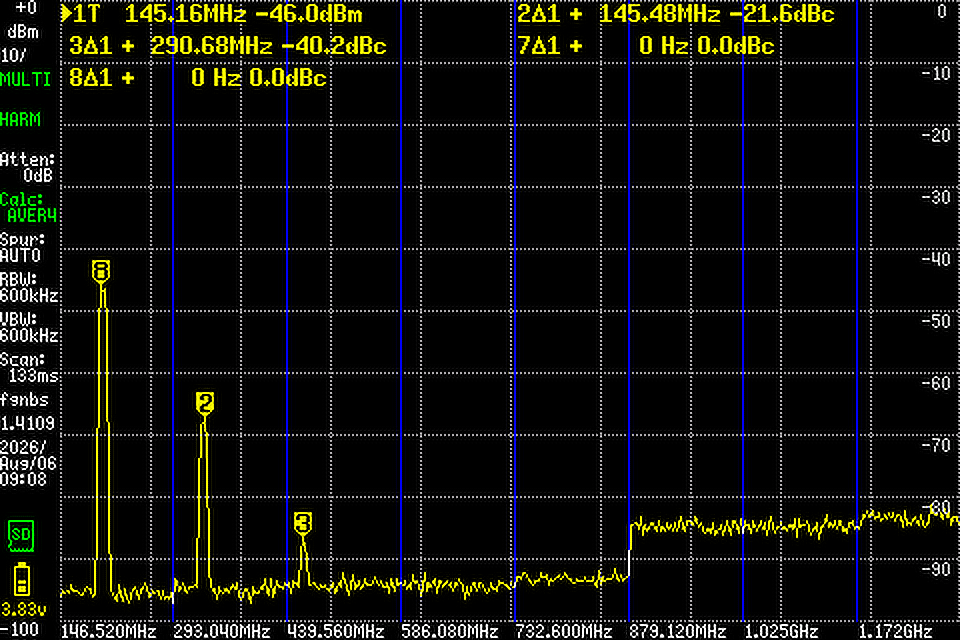
| Baofeng UV-5RX3 filtered | −46.0 | 30.9 | 1.2 W | −21.6 dBc@ 2f | −46.9 dBc | 8 mW ✘ |
Interpretation for the Baofeng UV-82 and the Mini-5.
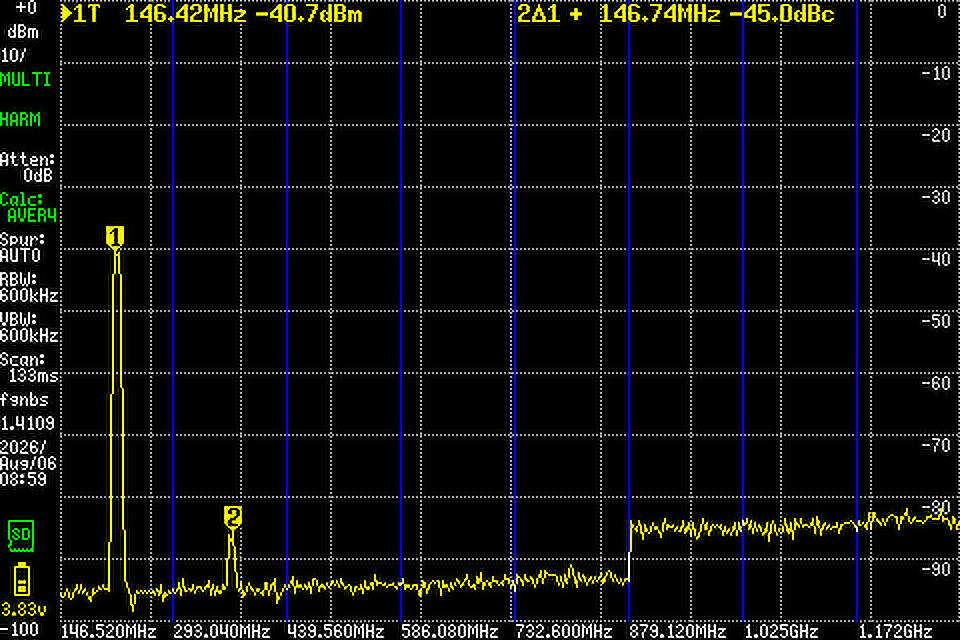
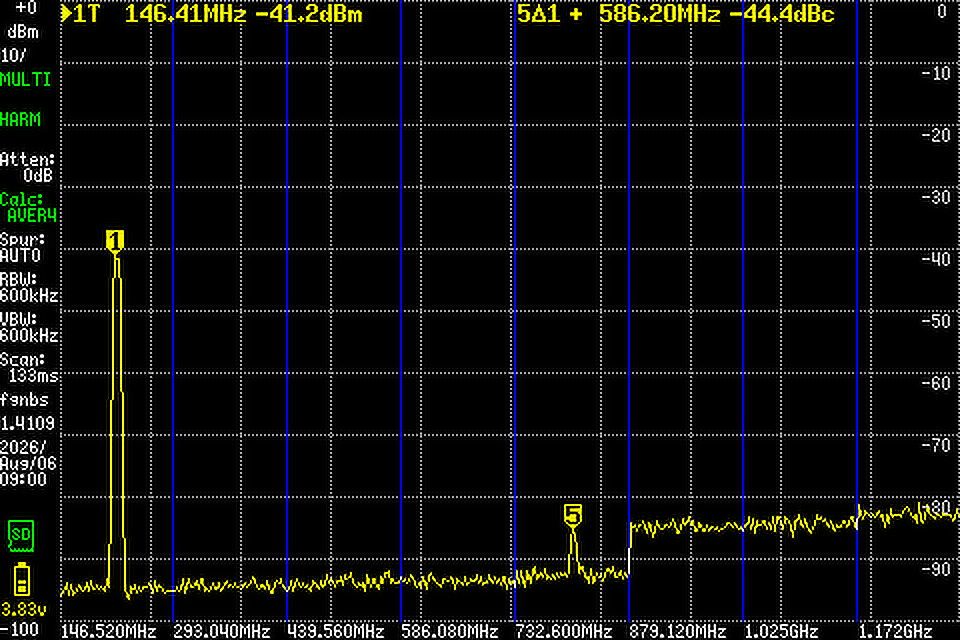
The standard for harmonic suppression for amateur radio on the VHF bands is that all harmonics should be down 40 dB - that is, the strongest harmonic should be -40 dB down from the fundamental (or -40 dBc - c for comparison). If we look down this 'Worst Harmonic' column, we see that the Baofeng UV-82 and Mini-5 pass this test! They have harmonics (unlike the IC W32A), but their energy level is satisfactorily low. As a Ham Radio Operator, this is the sort of thing we are supposed to understand. These radios are passing, so far, and at least by this test are perfectly legal to use on 2 meters.
But there is a problem with the 25 uW test. The rules also state that all harmonic energy should be below 25 uW for any radio transmitting 25 watts or less. In our tinySA and attenuation pathway, this means we should never measure harmonic energy above -16.02 dBm (25 uW), or at our tinySA after the 76.9 dB pads, that is -16.02 - 76.9 dBm, or -92.9 dBm. For the Baofeng UV-82, this means the harmonic power needs to be -52.2 dBc (down 52.2 dB) from the fundamental, which is at -40.7 dBm as measured at the tinySA. (-52.2 - 40.7 = -92.9 dB). Is it? Look at the 'Worst Harmonic' column, and you'll see it is at -45 dBc. Not low enough. -40.7 - 45 = -85.7 dBm, which is greater than -92.9 dBm. A similar calculation can be done for the 5th harmonic (the strongest) for the Baofeng UV-5R Mini. It also seems to fail. See the plots below for these two radios:
Baofeng UV-82
Baofeng UV-5R Mini
The problem I have with this 25 uW test, at least currently, is that the background noise level in these tests is at or above -93 dBm, so any peak would exceed the 25 uW cutoff. This suggests the background noise is flat and above 25 uW everywhere. Obviously something is wrong with this test. Perhaps I should try it with less attenuation someday. Stay tuned.
Interpretation for the Baofeng UV-5RM and UV-5RX3
These radios had terrible harmonics, with the worst being the second harmonic. Ignoring the 'Filtered' results for these radios for now, we see that the harmonic power is well above the required -40 dBc level. They fail, and right now we can simply say these radios can not be used on the ham bands. Not because the FCC hasn't authorized their usage, not even because these radio models tend to have this harmonic problem. But because we, as licensed operators, have done our due diligence and measured the output as a failure to comply with the rules. That's not on Baofeng; it is on us. Note: this is not a defense of this company's poor quality control; I am simply saying it is on the operator to comply with the rules. It is not on Baofeng. Anyway, it is also easy to see that these radios fail the 25 uW rule too (see table). Enough said on that.
Can we make the Baofeng UV-5RM and UV-5RX3 compliant?
We can attempt to filter the output of these radios to ensure compliance. This would be good amateur practice and is our responsibility. It's just that, with the abundance of commercial equipment, hams expect their Icom, Yaesu, or Kenwood to be compliant without having to think about it; hams unfortunately have become lazy appliance users. At the same time, I don't want to get in people's way of enjoying a hobby. If you don't want to think about it, buy an Icom, Yaesu, or Kenwood. The question for us now is, can we make our cheap Baofengs compliant by filtering?
To test this, I acquired the 2-meter filters offered by N6ARA. These passive devices are designed as band-pass filters for the 2-meter band, with sharp skirts that attenuate signals outside the band. This works in both directions - they are principally used for improving reception in high RF interference environments like hilltops with cell towers and pager transmitters on them. But in our case, I was hoping they would suppress the out-of-band harmonics we see. The results can be seen in the table (filtered rows) and in the plots (below). For the UV-5RM we see the filter can completely kill the 3rd harmonic, and it makes the second harmonic compliant by 0.8 dB. It's borderline but technically compliant. As for the 25 uW test, well, as above, I am not sure yet. Further testing is required. So in this case, the filter does seem to work. Also note that the filter, like most band-pass filters, exhibits significant attenuation even within the band-pass. It is about -2.5 to -3.0 dB for the filter I made; that is, about half the power, even in the band-pass region, is killed. You can see this as a drop from 7.4 watts to 3.5 watts. But it is now nearly clean.
The same can not be said for the UV-5RX3. The filter does knock the fundamental down (3.6 W to 1.2 W) and improves the second harmonic from −14.8 dBc to −21.6 dBc, but that is still far short of −40 dBc. The 2f spur remains about 8 mW — well above the 25 µW ceiling. Either way, it can't be made compliant with this filter.
Below are the plots for the unfiltered and filtered 5RM and 5RX3 radios. I'll have some final thoughts after those plots.
Baofeng UV-5RM
Baofeng UV-5RM / filtered
Baofeng UV-5RX3
Baofeng UV-5RX3 / filtered
Some final thoughts
So what do I actually take away from this?
First: these Baofengs all differ - not to mention there are rumors that different batches of the same model can differ in quality too. For me, the UV-82 and the UV-5R Mini both cleared the −40 dBc harmonic test on 2 meters. The UV-5RM and UV-5RX3 did not, and they failed it badly. If someone tells you "Baofengs are illegal!" they are being too general and don't sound like they really understand the rules. If someone tells you, "Mine is fine because I bought it on Amazon!" they probably don't understand the rules either.
Second: a band-pass filter is not magic, and it is not free. On the UV-5RM, the N6ARA 2 meter filter (about $40-55 USD) pulled the second harmonic just over the −40 dBc line and killed the third. It also ate about half the power (7.4 W down to 3.5 W). These little filters are only designed to handle 5 watts, so 7.4 W is still over the rating — less scary than the 10 W the first calibration implied, but not fine. On the UV-5RX3, the same filter dropped the fundamental (3.6 W to 1.2 W) and improved 2f from −14.8 dBc to −21.6 dBc — and that radio still fails. These radios should probably find themselves in the bin. Maybe they perform ok on UHF. Tests to come!
Third: I am not done with the 25 µW test. The −40 dBc numbers I trust more, because they are relative measurements on the same trace. Absolute spur power at 25 µW is near the noise floor of this setup once you put ~77 dB of pad in front of a tinySA. Until I rerun that with less attenuation, I am staying open-minded. The UV-5RM and UV-5RX3 second harmonics are not in that ambiguous zone. Those are obviously bad.
Fourth: The pads were light. Two labeled 40 dB attenuators are 76.9 dB together, not 80 dB. Pinning the Icom at 3 W on battery only caught 1.8 dB of that; the Mini at 3.7 W instead of 5 W caught the rest. Relative levels — the dBc numbers — were already fine, because a pad error is a common-mode offset. Absolute watts and the 25 µW column are the ones that moved.
None of this is a defense of Baofeng quality control. It is also not a call to throw every UV-5R in a drawer. Amateur radio is the service where the operator is the certification. That is the deal we signed up for. Buy an Icom if you want the factory to have already done this thinking - I have no problem with hams who think this way. Buy a Baofeng if you are willing to put it on a spectrum analyzer, read the markers, and live with the answer — including the answer that says "this was a waste of money".
I will try the 25 µW measurement again with a saner amount of attenuation. If the story changes, I will update the table or do another blog post. Until then: the UV-82 and Mini look usable on 2 m by the −40 dBc rule; the UV-5RM looks usable only with the filter if it doesn't melt the filter, and only just; the UV-5RX3 does not. Your radio is not this radio. Check it. You're a ham.