How many decimal places of π do you know? π is one of those numbers we call irrational . Rational numbers can be described as the ratio of two whole (integer) numbers. But π can not. There are no integers ‘a’ and ‘b’ such that a/b = π. This is true for many (actually infinite) other numbers such as √2 or √3. But π is a little different. It is transcendental as well. Either way, irrational numbers, when written out as a decimal expansion, never ends and never repeats. We can never write out all the numbers to fully account for its’ value. At least these are the conclusions of a body of mathematics called ‘real analysis’.
When I was a high school student a friend and I spend a few months trying to one-up each other with how many decimal places of π that we could remember. He won when he recalled 120 places. I never got past about 100. This is way behind the current record holder Suresh Kumar Sharma of India. He recited 7003021 decimal places in 17 hours and 14 minutes — Wow! Just wow! Let’s see how many I remember now:
3.1415926535897932384626… errr — I don’t remember any more.
And checking… that is 22 places and correct to 22 places. A random friend of mine (non-maths non-science type person) recalled five places correctly! I asked another friend and they remembered that π is approximated by 22/7, a rational number so it can only approximately ever estimate an irrational one. 22/7 is 3.142857 (and the decimal places start repeating) so it is wrong in the third decimal place.
How useful is knowing π to these approximate values?
Does anyone ever really need to know π to 7003021 decimal places? Well, I’m glad you asked! By definition π is the ratio of the circumference of a circle to its’ diameter, so let’s use the humble circle to investigate how much (many decimal places of) π you need to accurately construct a circle in the real world and eventually on the scale of the universe. Let’s start with something simple. I drew the following circle on paper using my pencil holder as a template.
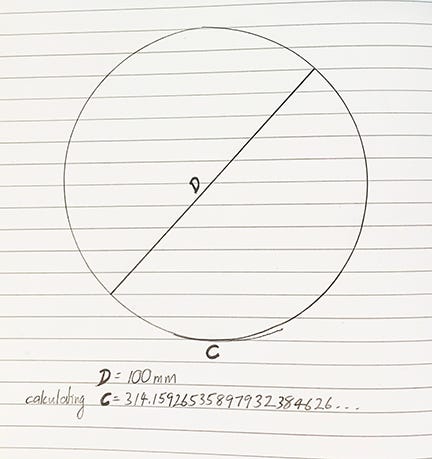
It turns out the diameter (D) is about 100 millimetres (mm) so let’s just say it is exactly 100 mm. So the circumference is easy to calculate and is ~314.159 mm if we use the five decimal places my friend remembers. What about with how many places I remember? Well then the circumference is 314.15926535897932384626 mm.
When you think about the circumference with this many decimal places doesn’t it seem a little strange? 314.159 mm is pretty precise. The last decimal place is telling us that the circumference is not 314.158 mm or 314.160 mm, but 314.159 mm. That’s a precision of 1/1000 of a millimeter, or a precision of 1 μm. To put this in perspective a human hair is about 50 μm wide, much larger than our error. A typical bacterial cell is 1μm wide or on the scale of our error. So for objects like pencil holders, or cups or other things you can hold in your hand, if you know its’ diameter and the value of π to 5 decimal places, you can calculate its’ circumference to within the size of a bacterial cell. This seems like enough precision for hand-holdable objects, no?
Interlude: A non-rigorous proof of how errors in π propagate from diameter to circumference.
Lets start by assuming we know π to one decimal place: 3.1:. By this we are also claiming that π is not 3.0 or 3.2. This is we are saying π is 3.1±0.1. Similarly if we state that π is 3.14, when we are saying π is not 3.13 or 3.15 but 3.14±0.01. Now, by non-rigorous induction we can conclude that if we know π to n decimal places then the error range we know π to is 1/10ⁿ. Because calculating circumference from diameter and π is a simple linear function the error in π translates directly to the error in circumference. Example: π is ≈3.1 or n=1 decimal places. So if diameter is 20 meters, circumference is ≈62 meters. It is not 60 meters or 64 meters. We know the diameter to ±1/10¹ times 20 meters or ±2 meters (since n=1). If we know π to 5 decimal places (n=5) then we can calculate the circumference to within ±1/10⁵ of 20 meters, or 0.0002 meters (200μm!)
Do I need all the π I know?
Remember how I can recall π to 22 decimal places? What can I do with this knowledge? Using the argument above but to again calculate the precision of the circumference of our drawn circle above, we would know the accuracy to 1/10²² of 100 millimeters or 1/10²³ meters. Is anything even that small? I’m glad you asked! A proton is estimated to have a width of 0.8418±0.0007 femtometers — a femtometer is 1/10¹⁵ meters — so our accuracy about the circumference of a pencil holder is about 10⁸ times better (smaller) than the width of a proton… i.e. much much smaller than a proton.
If you are interested, as an exercise figure out the accuracy of the circumference of the universe if you know the diameter is about 93 billion light years using π to 5, 22 or even 7003021 decimal places. I’ll post the answers below…
Let’s get a little philosophical
I just checked the accuracy of the value of π used internally in the Python programming language. It is 15 decimal places, which also seems overkill for practical purposes. This is obviously more accurate than 22/7 but it does remind us that for numerical calculations used on a daily basis we can absolutely know enough π — it’s irrationality should not lead us to believe we can’t make accurate calculations in the real world. So if it is not useful knowing π to 5 (maybe), 15, 22, 120 or 7003021 decimal places, why are some people obsessed with knowing π so accurately? For my high school friend and I it was all about bragging rights. It had nothing to do with knowing anything real or useful at all. He didn’t become a better engineer or mathematician because he knew π better than me. I think the obsession comes from the mystery of a number than can never be fully captured in an expressed (written) numerical form. It dares (some of) us to know it as much as possible. We try to tame it’s irrationality but only ever end up demonstrating the impracticality of the irrationality. I don’t deny the existence of the irrationals per se, but their existence only manifests in an idealized axiomatic systems of continuous spaces like Euclidean space. But I will add, in my opinion, continuous Euclidean space is nothing but an invention of people. Irrationals only exist because we define a system in which only they can exist. They don’t HAVE to exist! If you disagree, I’d love to hear about it in the comments below.
How much π do YOU want to know?
Seriously, comment below. What do you think is a useful amount of π to memorize? Justify your answer with any arbitrary importance you want to place on it. I’m genuinely curious what people think.
Answers to “Circumference Of The Universe” Quiz
OK. 93 billion light years is 8.7984793395x10²⁶ meters. So assuming the universe is a circle (it isn’t, but it’s not a Euclidean space either! It’s debatable if it is continuous) the error from using a limited number (n) of decimal points of π will be 1/10^n of the circumference. Circumference is easy to calculate of course:
c = π ⋅ 8.7984793395x1⁰²⁶ meters = 27.6412380557x10²⁶ meters.
So if we know π to 5 decimal places we know this circumference to 1/10⁵ of 8.7984793395x10²⁶ or 8.7984793395x10²¹ meters — this is about the size of a galaxy. A significant error I guess.
If we know π to 22 decimal places we know this circumference to 1/10²² of 8.7984793395x10²⁶ or 8.7984793395x10⁴ meters — this is about 1/455 the size of the circumference of the earth or about 87 kilometers (55 miles). About how far you can travel by car in an hour.
If we know π to 7003021 decimal places we know this circumference to 1/10⁷⁰⁰³⁰²¹ of 8.7984793395x10²⁶ or 8.7984793395x10⁻⁷⁰⁰²⁹⁹⁵ meters — This is so small don’t even think about it. If you’re curious about very small distances read about Plank’s length and you will see how ridiculously small this distance is.